Alex Huber, OE5AUH will be active as 8Q7AH from Maldive Islands, IOTA AS - 013.
8Q7AH call is used before.
Recent DX Spots 8Q7AH
Previous activity:
Henry, LU4DXU will be active as 8Q7AH from Dharavandhoo Island, Maldive Islands, IOTA AS - 013, 8 - 15 February 2022.
He will operate on HF Bands, using Yaesu FT-891 transceiver with HLA-300 amplifier and dipoles antennas.
QSL via LU4DXU direct.
Ads for direct QSL:
HORACIO ENRIQUE LEDO, MANZANARES 4586 - P 2, Dto. 4 - C.A.B.A. (1430), BUENOS AIRES, Argentina.
Maldives
The Maldives, located in South Asia, is synonymous with utopia — the most beautiful and desirable place for humans. Indeed, it is difficult to imagine anything more perfect than a circle of beautiful islands in the middle of the boundless ocean. Twenty-six atolls, united into a single archipelago, are located 700 km from India, south of the island of Lakshadweep and southwest of the state of Sri Lanka. This elegant coral chain, casually thrown into the Indian Ocean by higher powers, is called the Republic of Maldives.
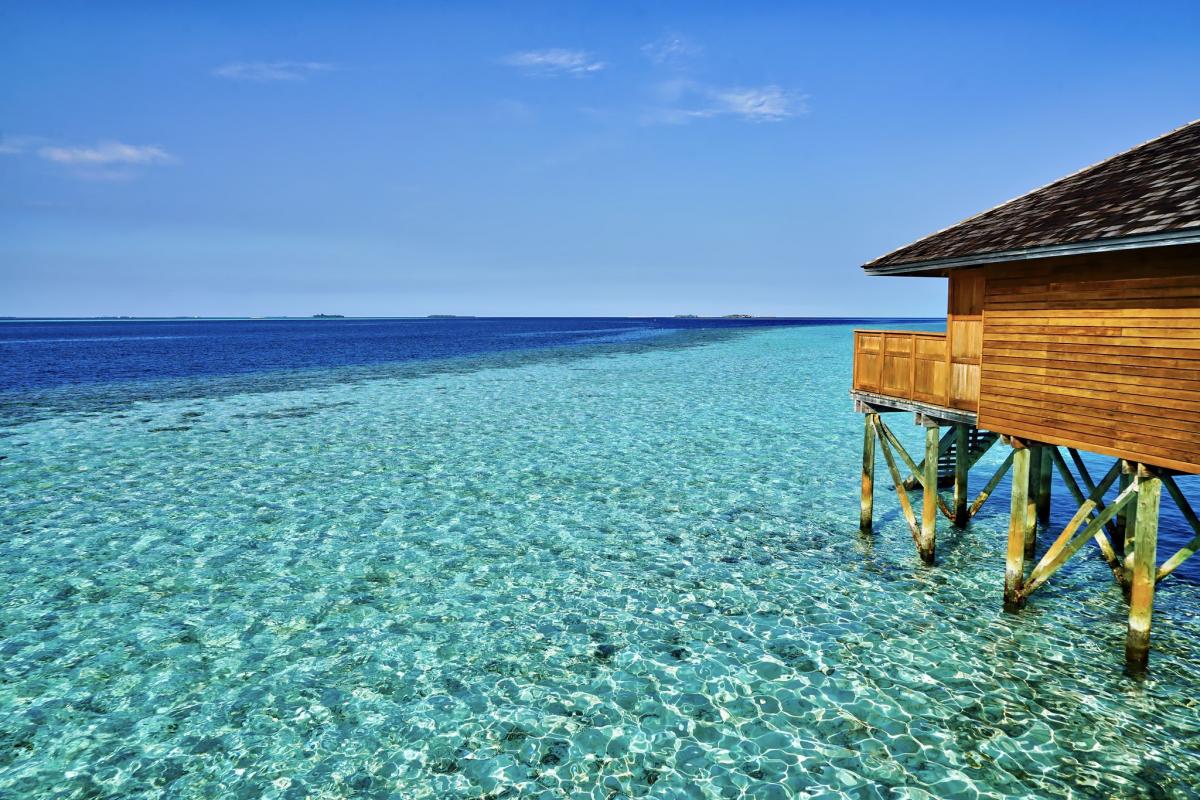 Maldive Islands. Author - Michael Jeddah.
Geography of the coral state
On the world map, the beautiful Maldives are located between 1° and 8° north latitude and 72° and 74° east longitude. The Maldives consist of a huge number of islands and islets, 1,192 in total, which barely rise above sea level. The highest point of the Addu archipelago reaches only 2.4 m, and therefore, from a bird's eye view, this paradise looks very impressive. It is as if the entire infrastructure of the state is built right in the middle of the vast power of the formidable ocean.
The official area of the Maldives is 90,000 km2, and the area of inhabited land is only 298 km2. 110 microscopic resort islands are not visible on the world map, and you can walk across them in just 20 minutes at a leisurely pace. Interestingly, all the islands are the peaks of the Chagos-Laccadive underwater ridge, which is why new atolls are constantly forming here. Shipping lanes are provided by large straits to the south of the ridge, known as the Equatorial Passage and the One-and-a-Half Degree Passage.
The state of the Maldives has only one city, which is home to the majority of its population. One city, one port, and, logically, it is also the capital of the coral chain.
The capital of paradise — Malé
The population of the state is about 400,000 people, more than 135,000 of whom live in the capital, which gives it the right to be considered one of the most densely populated cities in the world. Malé covers an area of 6,800 km2 and is estimated to be the size of four large islands: Malé, Villingili, Hulhumale, and Hulule. The capital is part of the Kaafu Atoll, which in turn consists of three atolls, including Malé. Malé itself consists of North and South Malé. Thus, the geography of the coral state resembles the hierarchy of Russian nesting dolls: large atolls are divided into smaller ones, which in turn are divided into even smaller ones...
The appearance of Male as a capital city is no different from most European cities. Modern concrete and glass buildings, bridges, an airfield, sidewalks, shops, hotels... Standing in the heart of the capital, it is difficult to imagine that this island of civilization is suspended in the middle of the majestic ocean. The name of the city of Malé comes from the Indo-European term male (“to rise, to grow”), and the name of the state — Maldives — consists of a combination of the words male and the Sanskrit form divy (“island”).
This, in fact, characterizes the way of life of the newly formed republic — nothing superfluous, everything as it is!
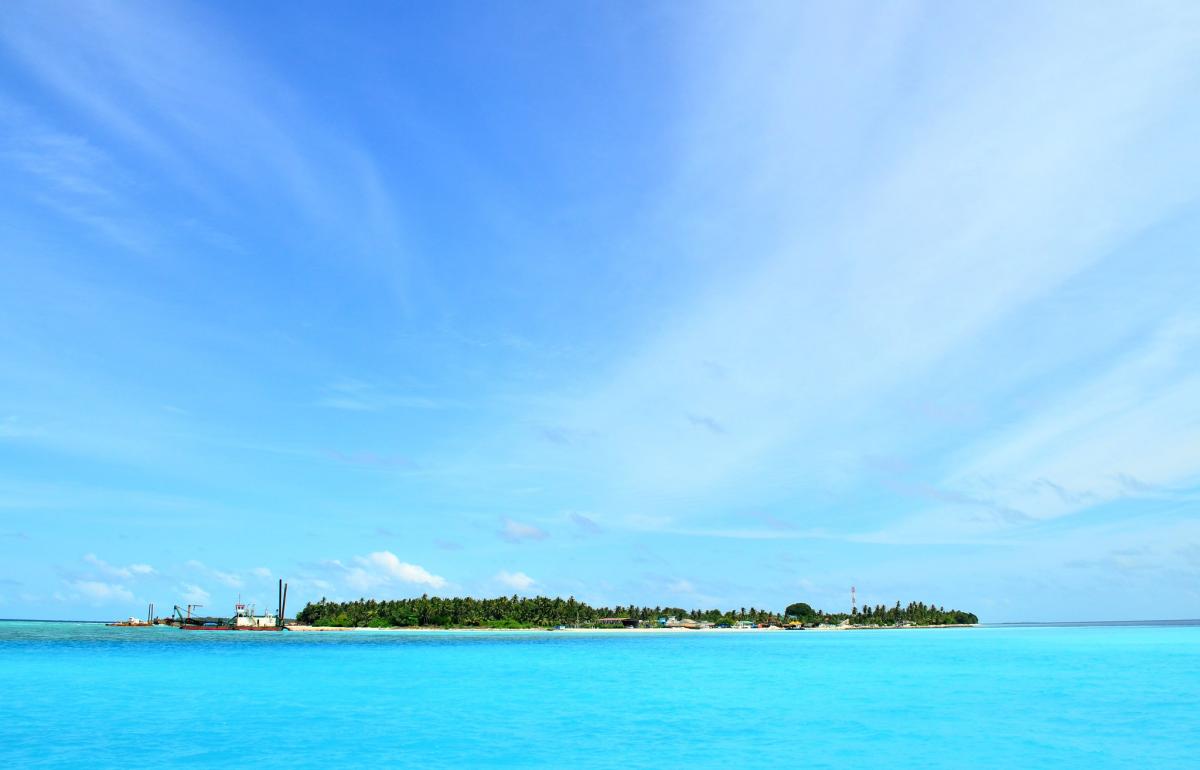 Dhavarandhoo Island, Maldive Islands. Author - Mohamed Malik.
The ancient history of the archipelago
Due to its geography, the Maldives, located on major sea routes, was settled a very long time ago — about 2,000 years ago. Its close proximity to India and Sri Lanka led to the spread of Buddhism on the islands as early as the 12th century. Followers of Buddha settled on the islands to harvest and export unique cowrie shells, which were used as currency in Asia and Africa at the time. After the 12th century, the Maldives were conquered by the Arabs, which led to the displacement of Buddhism and the introduction of Islam. The Arab navigator and statesman Abu al-Barakat was so impressed by the beauty and prospects of the wonderful archipelago that he proclaimed himself sultan. The newly appointed ruler, Muhammad ul Abdul, founded the Sultanate of Malé, which occupied the paradise islands for as long as four centuries.
In the 15th century, the tireless explorer Vasco da Gama brought the existence of the Maldives to the attention of the major powers, which subsequently led to the decline of the Arab dynasty. From that moment on, the Portuguese, Dutch, French, and British actively captured the islands with varying degrees of success, but were invariably repelled by the indigenous population. At the end of the 19th century, powerful India set its sights on this tasty morsel in the Indian Ocean, and the Maldivians had to choose between two evils. In 1887, the Maldives became a British protectorate on paper and a naval base in the ocean in reality.
The long-awaited independence of the archipelago was brought about by Amir Ibrahim Nasir, an active public figure in the state, who achieved republic status for the islands in 1968. From that moment on, the republic became presidential, the local currency, the rufiyaa, became official, and its own state symbols were formed.
The symbolism of the coral chain of the Indian Ocean
Since the island has retained its main religion, Islam, the state coat of arms is marked by its main symbols. A gold star and crescent moon are located in the center of the coat of arms of the Maldives. The main national tree of the Maldives, the coconut palm, crowns this relic of Islam. On either side of the central figure of the coat of arms, the flags of the state fly like two formidable guards. At the bottom of the symbol is a ribbon with the motto “Mahal Dibiyat,” which means the ancient name of the Maldives in Arabic. The motto ribbon clearly indicates the respect with which the local population treats the founders of their land.
The flag of the Maldives is undoubtedly laconic, but eloquent.
The red background symbolizes the islanders' centuries-long struggle for freedom, while the lush green rectangle represents the color of the palm tree, which brings income to the state. The thin white crescent moon shows the world the local population's commitment to their religion, Islam.
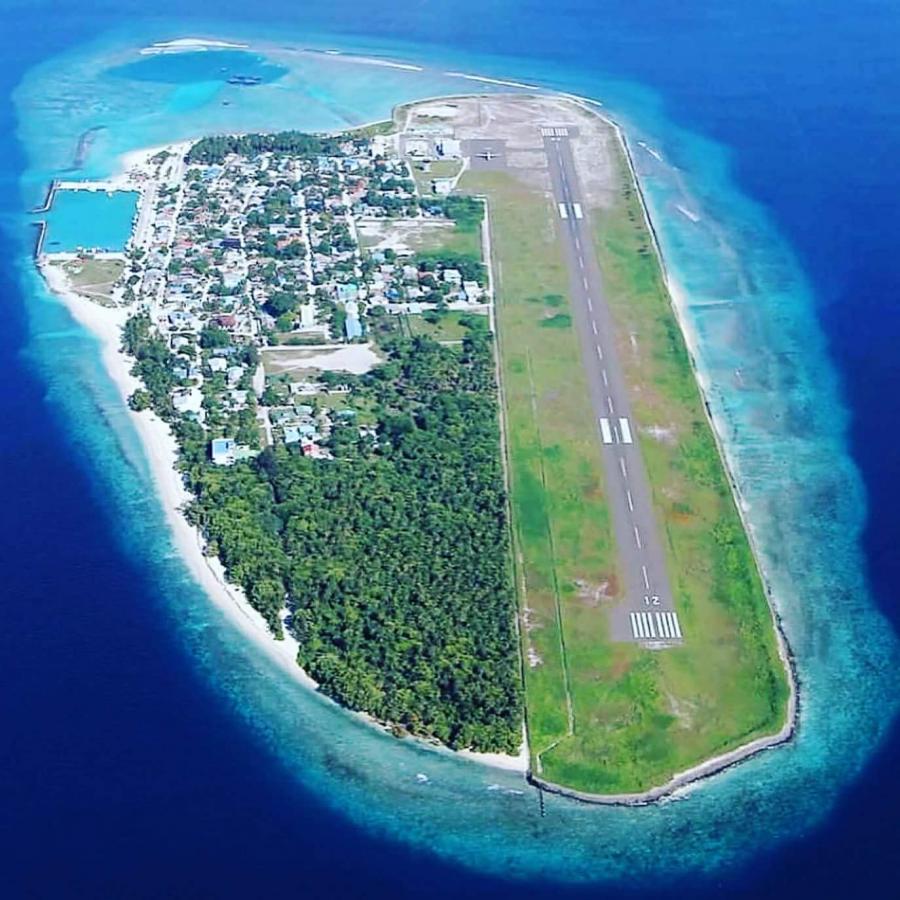 Dharavandhoo Island, Maldive Islands.
Maldivians — language, population
Maldivians are a mixed race of Dhivehi people, formed by immigrants from Asia, India, Pakistan, and Bangladesh. Dhivehi, or Maldivian, is the language of the indigenous population, which belongs to the Indo-Iranian language group. In addition to the main population, a small number of Indians, Arabs, Sinhalese, and Pakistanis permanently reside on the islands. Due to the highly developed tourism industry in the Maldives, English is also widely spoken, and many words have entered the everyday slang of the islanders.
Most of the inhabitants of the Maldives are Muslims who strictly adhere to their faith, Sunni Islam. Mosques rise everywhere, and obligatory prayers are performed five times a day. It is important to know that the activities of other religions are not welcome and are met with open hostility. In general, the islanders are good-natured and hospitable, and their rhythm of life is one of unhurried enjoyment of the paradise-like nature. The occupations of ordinary Maldivians are simple and undemanding: fishing, making souvenirs, working in the tourism business, and contemplating the surrounding beauty.
The climate of the Maldives is blissful!
The southern part of the equator runs like a red line through the Maldives, which determines the extremely favorable climate of the state. This is the tropics at its best! The absence of seasonal weather and heavy rains makes the archipelago one of the most amazing and popular resort destinations on earth. The seasons are determined by winds and humidity. From May to September, the southwest monsoon (hulhangu) prevails, and from December to April, the northeast monsoon (iruvai) takes over. The average daytime temperature throughout the year reaches +30 °C, and at night, it is no more and no less than +25 °C.
Island flora and fauna
The nature of the Maldives can be described in a few sparse but meaningful words: snow-white sand, green palm trees, incredible corals, and azure ocean waters... However, thanks to human labor, you can also see bamboo, mangrove and eucalyptus forests, and banana groves here. The ultra-warm and stable climate is conducive to the growth of orchids, hibiscus, tropical shrubs, and exotic flowers.
The fauna of the Maldives includes gray herons, bats, lizards, and small tupaia monkeys. The bird life on the islands is even richer: more than 150 species nest freely on these paradise islands. Among the birds here, you can see frigatebirds, petrels, terns, and, of course, temporary winter migrants from European countries. Another plus for this wonderful resort is the complete absence of poisonous snakes and insects. That is why the Maldives is called a true paradise on earth!
The marine fauna of the islands is as rich as the Indian Ocean itself. More than 1,000 species of fish, 5 species of turtles, more than 20 species of whales, more than 150 species of shrimp, and about 50 species of crabs can be found in the waters of the state. Coral reefs are a cozy haven for any representative of the seabed: from plankton to tiger sharks.
Notable places in the Maldives
Naturally, the main asset of the republic is the atolls of unreal beauty with the purest transparent waters — the dreams and fantasies of diving enthusiasts around the world. The Addu Atoll can delight tourists with its freshwater lake, while in the Baa Atoll, you should visit the Hanifaru Bay nature reserve. The Dhaanu Atoll is famous for its giant turtles, and the Lhaviyani Atoll for its beautiful sandbars...
For admirers of local culture, the islanders recommend visiting the majestic Friday Mosque, built in the 17th century, which houses preserved ancient artifacts. Sultan Park is a silent witness to the historical events of the Arab dynasty's reign, where tourists can feel the relentless passage of time. Relics and evidence of the times that have come down to us are collected in the National Museum and the National Art Gallery, which you can take your time to explore between entertainment in the empire of water and sun. In general, the Maldives archipelago itself is the brightest attraction of our amazing planet!